
2026 Q2 East Asia Reinsurance Market Briefing
A visual briefing on the key capital, solvency and reinsurance developments covered in the 2026 Q2 East Asia Reinsurance Market Report.

A visual briefing on the key capital, solvency and reinsurance developments covered in the 2026 Q2 East Asia Reinsurance Market Report.
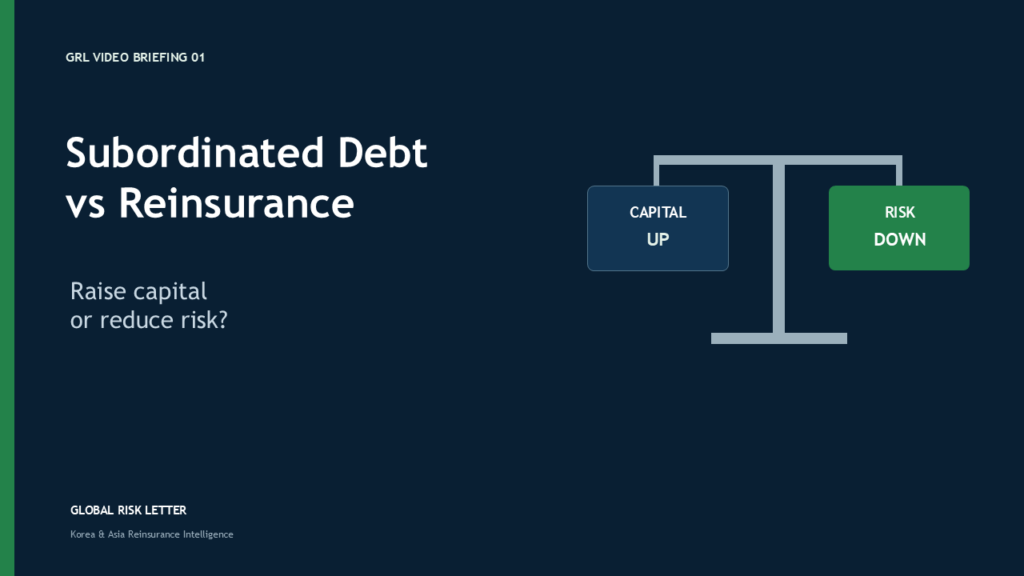
Subordinated debt and reinsurance can both strengthen a solvency ratio, but through very different mechanisms. This visual briefing compares capital raising with genuine risk transfer under K-ICS.
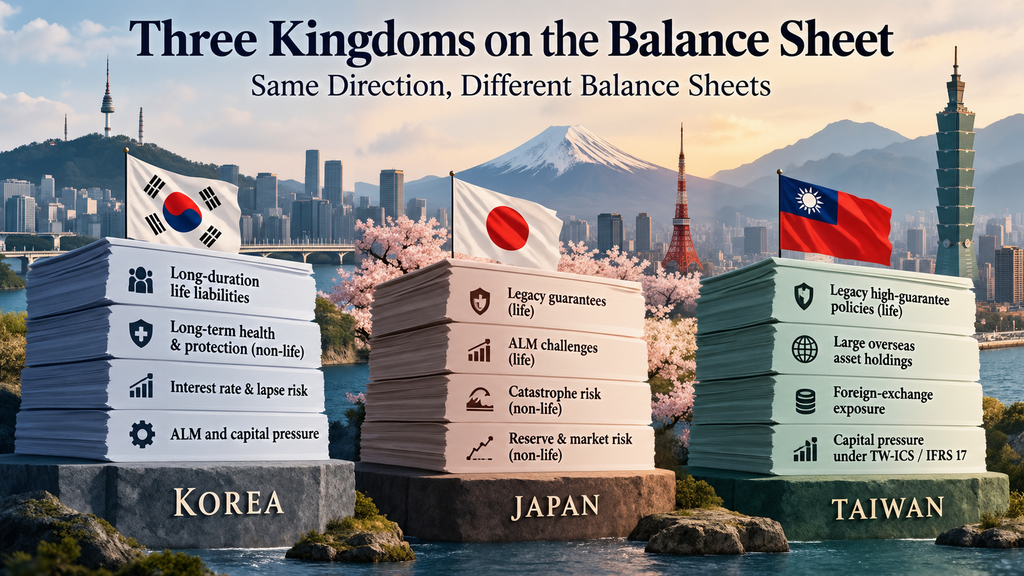
Korea, Japan and Taiwan are entering a new era of risk-based solvency regulation. K-ICS, J-ICS and TW-ICS are reshaping how insurers manage capital, transfer risk and design their balance sheets.

As reinsurance pricing eases, insurers face a strategic choice: buy more protection, redesign the programme, or retain the savings.

Longevity swaps and alternative risk transfer could offer Korean insurers new ways to manage longevity exposure, capital pressure and long-duration liabilities beyond traditional reinsurance.

As societies age rapidly, life insurers face growing pressure from longevity risk, long-duration liabilities and asset-liability mismatch. Capital management and reinsurance strategy are becoming increasingly interconnected.

Structured reinsurance is becoming an important tool for Korean insurers seeking to optimize K-ICS, transfer capital-intensive risks and improve balance-sheet efficiency.

K-ICS is changing the role of reinsurance in Korea. Insurers are increasingly using risk transfer not only for underwriting protection, but also as a tool for capital management and balance-sheet optimization.

Korea’s non-life insurers are under increasing capital pressure as long-duration health and accident portfolios collide with K-ICS requirements, weaker profitability and limited traditional reinsurance solutions.

Japan’s transition to J-ICS is changing how insurers assess capital, risk and reinsurance. The new solvency framework is likely to reshape balance-sheet strategy across the market.